Scope
The standard applies to railway vehicles carrying passengers and, with some differences, to vehicles running on the network such as locomotives and service vehicles. It covers materials that can contribute to a fire: interior linings, floors, seats, insulation, seals, cables, electrical components, resins and foams.
Metals and inorganic materials are generally considered non-combustible and do not require testing. The work therefore focuses on polymers, composites, textiles and paints.
How the hazard level is determined
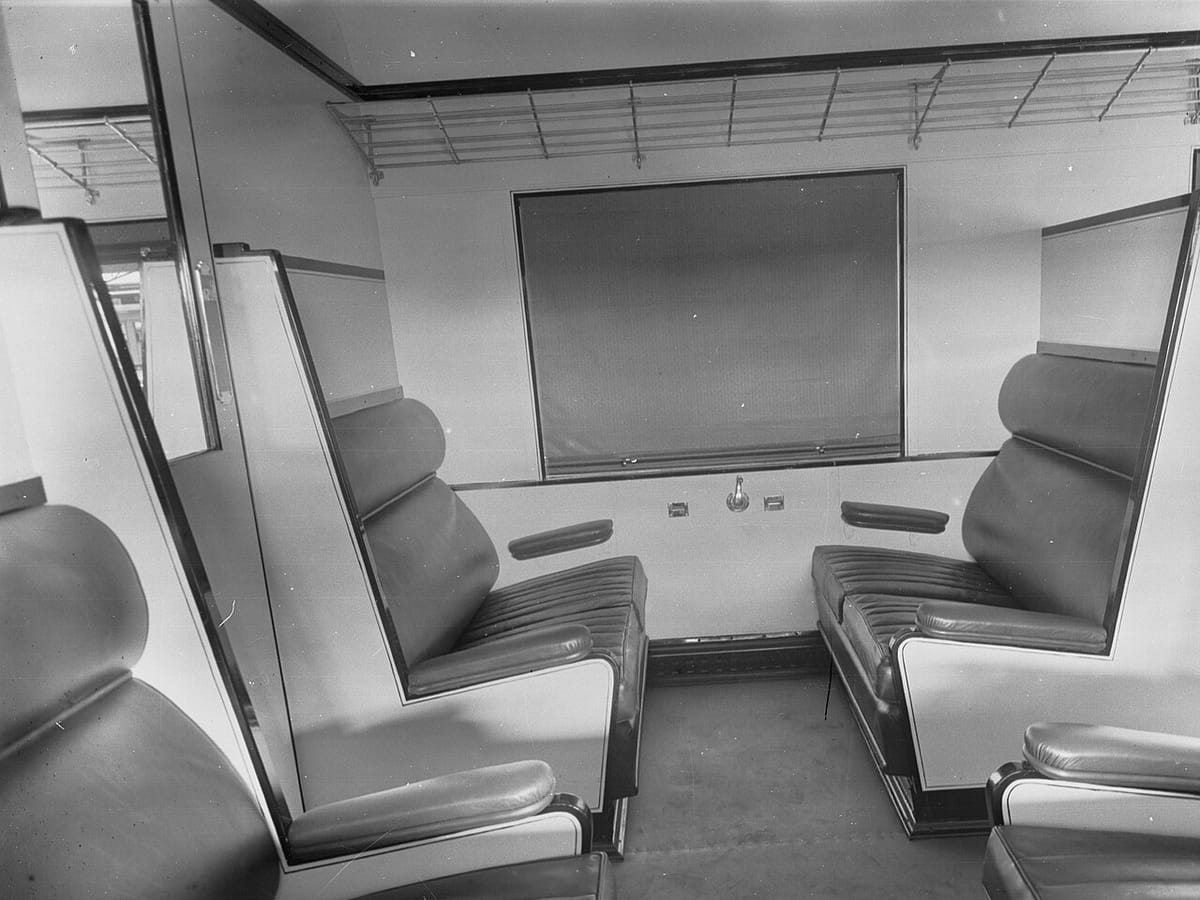
The starting point is EN 45545-1, which defines the operation category of the vehicle according to the type of line: presence of tunnels, elevated sections, and the time needed to stop at a safe place and evacuate passengers. To this is added the design category, which distinguishes the standard vehicle from double-deck vehicles, sleeping cars or automatic vehicles with no staff on board.
Combining the two categories gives the hazard level HL1, HL2 or HL3. HL3 is the most severe and applies, for example, to vehicles running through long tunnels. The same material may be acceptable for a street tram and not for a high-speed train.
Requirement sets R1–R26
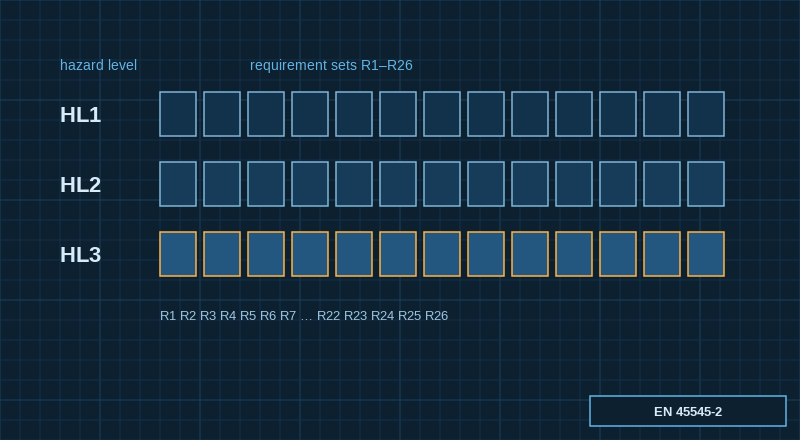
Each product is assigned a requirement set according to its location and function. The standard contains a list of the most common products with the corresponding set; for products not in the list there are generic sets.
For each set the standard specifies which tests to carry out and the limit values to meet for HL1, HL2 and HL3. There are also rules for components of small mass or small surface area and for grouping several parts, which can reduce the tests needed. The details of these rules change with the edition of the standard.
Reaction-to-fire, smoke and toxicity tests
The tests measure different quantities and each set requires a combination of them. The most common ones are:
- Lateral flame spread on surfaces (ISO 5658-2)
- Heat release rate with the cone calorimeter (ISO 5660-1)
- Smoke density in a closed chamber (EN ISO 5659-2)
- Toxicity of combustion gases, expressed as a conventional index
- Limiting oxygen index (EN ISO 4589-2)
- Ignitability with a small flame (EN ISO 11925-2)
- Specific tests for complete seats and for cables
Documents to prepare and common mistakes
In practice you build a materials matrix: for each item you state location, mass or surface area, requirement set, HL level and the test report that demonstrates compliance.
The most common mistakes are test reports referring to a thickness, colour or formulation different from those actually fitted, tests carried out to a superseded edition of the standard, components overlooked because they are small or supplied inside a sub-assembly, and requirement sets chosen by analogy without checking the actual location. Ranieri — Servizi di ingegneria prepares the material compliance matrix and the list of missing tests, while the tests themselves remain the responsibility of accredited laboratories.
The other parts of the EN 45545 series
Part 1 defines categories and general principles. The following parts cover fire barriers, vehicle design requirements, electrical equipment, fire detection and fire fighting, and systems with flammable liquids and gases. Part 2 is the one that directly involves material suppliers.
Frequently asked questions
What is the difference between HL1, HL2 and HL3?
They are the three hazard levels of the vehicle. They depend on the operation category and the design category defined in EN 45545-1. HL3 is the most severe and has the strictest limits for flame, heat, smoke and toxicity.
How do I find out which R requirement applies to my component?
Start from the location and function of the product and look for the corresponding entry in the list in the standard. If the product is not listed, the generic sets are used, taking into account the rules for small components.
Is a test report valid for ever?
It is valid for the material tested, with that formulation and that thickness, and according to the edition of the standard used. If the product changes or the standard requires different methods, the report may no longer be accepted.
Does EN 45545-2 replace the old national standards?
Yes, in Europe it has taken the place of national standards on fire behaviour such as the French, German and Italian ones.
Summary for information only: the requirements are those of the official text of the standard in its current edition, available from the standards bodies. Ranieri — Servizi di ingegneria covers the mechanical side and does not carry out work reserved to members of a professional register.