
Scope
The series applies to the welding of metallic materials in the manufacture and maintenance of railway vehicles and their sub-assemblies: car bodies, frames, bogies, equipment supports, tanks and brackets. It covers both the vehicle manufacturer and the suppliers who deliver welded parts.
Many customers in the sector require EN 15085 certification as a condition for placing an order, even for simple components.
The parts of the standard
- Part 1: terms and general principles
- Part 2: requirements for the welding manufacturer and certification levels
- Part 3: design requirements and joint classification
- Part 4: production requirements, procedures and qualifications
- Part 5: inspection, testing and documentation
- Part 6: requirements for welding in maintenance
Part 2: certification of manufacturers CL1–CL4
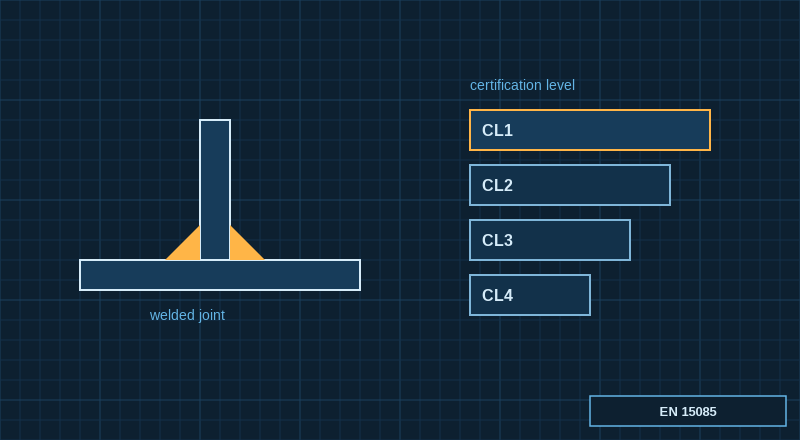
Part 2 defines the certification levels. CL1 is the highest level and allows even the most critical joints to be welded; CL2 and CL3 cover progressively less demanding joints; CL4 applies to those who do not weld but are responsible for designing, purchasing or selling welded parts. The level required depends on the joint classes the company has to produce.
To obtain certification you need a welding coordinator with the qualification appropriate to the level, qualified welders, approved procedures and a documented system. Certification is issued by a recognised body and must be maintained through periodic audits.
Part 3: joint classes and quality levels
The design core of the standard is the classification of every welded joint. Two criteria are combined: the stress category, linked to how highly the joint is utilised in fatigue relative to its strength, and the safety category, linked to the consequences of a failure for people and for operation.
The combination gives the weld performance class, from CP A, the most severe, down to CP D. Each class refers to a quality level for imperfections according to the ISO standards on weld quality and to an inspection class, which defines which inspections to carry out and to what extent. The class must be shown on the drawings.
Parts 4 and 5: production, inspection and documents
Part 4 covers production: qualified welding procedure specifications, qualified welders and operators, production tests where required, management of filler materials and edge preparation. Part 5 covers visual and non-destructive testing, the personnel carrying it out and the documentation to be kept for traceability.
Ranieri — Servizi di ingegneria can prepare the joint classification of a sub-assembly according to part 3, with the information to be shown on the drawings; certification of the manufacturer remains the task of the certification body.
Common mistakes
- Drawings without a joint class, leaving the choice of inspections to the workshop
- All joints classified at the highest level out of caution, with unnecessary inspection costs
- Stress category assigned without a supporting fatigue calculation
- Supplier certification level not matching the joint classes required
- Qualified procedures that do not cover the actual thicknesses, positions or materials
Frequently asked questions
What is the difference between CL1, CL2, CL3 and CL4?
They are the manufacturer certification levels defined in EN 15085-2. CL1 covers the most critical joints, CL2 and CL3 progressively less severe classes, and CL4 those who design or purchase without welding. The level needed depends on the joint classes to be produced.
What do CP A, CP B, CP C and CP D mean?
They are the weld performance classes of EN 15085-3, obtained by combining stress category and safety category. CP A is the most severe; each class determines the quality level and the inspections required.
Who issues EN 15085-2 certification?
A certification body recognised for the railway sector, after an audit of the company, the welding coordinator and the procedures. Certification has limited validity and must be renewed.
Is EN ISO 3834 enough for welding in the railway sector?
EN ISO 3834 defines quality requirements for welding in general and is referenced by EN 15085, but for railway vehicles customers normally require the specific EN 15085-2 certification.
Summary for information only: the requirements are those of the official text of the standard in its current edition, available from the standards bodies. Ranieri — Servizi di ingegneria covers the mechanical side and does not carry out work reserved to members of a professional register.